Executive Summary
The popular framing of "vibe coding" promises that AI will let anyone describe what they want and ship it as a product. The premise contains real truth, but it omits the variable that matters most: the human directing the AI. This paper, drawn from two months of real-world development of a full-stack, multi-tenant production platform built collaboratively with Claude Code, examines what actually separates demos from production systems in the era of AI-assisted development — and names the role that decides the outcome: the Forward-Deployed Engineer.
The headline finding: when coding is no longer the bottleneck, thinking becomes the bottleneck. The architect's contribution to vision, judgment, domain expertise, dependency-aware design, and platform thinking is not displaced by AI. It is amplified by it. End users with AI assistants can now go further than ever, but they hit a wall the moment system complexity demands questions they cannot ask. Traditional developers whose primary contribution was translating specs into code are being absorbed. The architect — defined less by title than by mode of thinking, and in this paper named the Forward-Deployed Engineer — becomes the bridge.
Eleven practitioner lessons follow. They are written for aspiring vibe coders who want their work to survive contact with production reality.
The deepest competitive advantage in AI-assisted development is not knowing how to talk to the AI; it is knowing enough about your problem domain that the AI's output can be properly evaluated, challenged, and refined.
Introduction: The Promise and the Reality
The term "vibe coding" has captured the imagination of a generation of developers and entrepreneurs. The premise is seductive: describe what you want, let the AI write it, and then you ship it as a product. No deep technical knowledge required. Just vibes.
There is truth in this. AI coding assistants like Claude Code have fundamentally changed what a single person can build in a compressed timeframe. But the vibe coding narrative, as popularly told, leaves out something critical: the human on the other end of the conversation matters enormously — not just as a prompt engineer, but as a thinker, a decision-maker, and ideally as someone who understands systems at a deeper level than the code itself.
This whitepaper draws on two months of intensive, real-world development of a full-stack, multi-tenant production platform, built collaboratively between a Forward-Deployed Engineer — a Solutions Architect with decades of enterprise experience — and Claude Code. The system included a Node.js REST API, a React/TypeScript frontend, MySQL with Sequelize ORM, a geospatial mapping layer, deeply integrated AI advisory, automated multi-stage business workflows, portfolio and entity management, an integrated help system, and a fully automated multi-environment setup and migration process. The domain itself is deliberately left unnamed: the lessons are about building production platforms, and they hold regardless of the industry the platform serves.
A word on framing: throughout this paper, the human in the loop is called the Forward-Deployed Engineer (FDE) — a senior architect embedded directly in the problem, building alongside the AI rather than handing specifications down a chain, owning the judgment calls, and staying accountable for what reaches production. The FDE is the role the AI era rewards; the eleven lessons that follow are, in effect, a description of what that role does.
What follows are the lessons that emerged — not from a tutorial, but from the trenches.
1. The Partnership Model
AI is only as good as its other half.
The single most important insight from this journey is one the vibe coding community rarely discusses: the AI is only as effective as the human directing it.
Claude Code can write a seed script, fix a TypeScript error, design a database schema, and debug a CORS configuration. It does these things quickly and with impressive accuracy. But it cannot decide what to build, why it matters, or when a solution isn't good enough. Those judgments belong to the human.
Over two months of development, the moments of greatest frustration — login failures that kept reappearing, seed scripts that failed in test but not in dev, stored procedures that existed only on one machine — were resolved not by smarter prompting, but by the human architect recognizing patterns, asking the right diagnostic questions, and knowing when to step back and redesign rather than patch the symptom.
Aspiring vibe coders should internalize this early. If you abandon the critical thinking process, the AI will fill the gap with plausible-sounding solutions that may not hold up under real-world conditions.
The corollary is equally true: when the human brings genuine expertise, the AI's output quality rises dramatically. An experienced architect knows what questions to ask, what constraints to enforce, and what "good enough" looks like. That knowledge shapes every interaction and dramatically narrows the solution space the AI needs to search.
There is a temporal dimension to this partnership that the vibe coding narrative ignores entirely: the AI does not remember. Each session begins from a blank slate — no recollection of the architecture you settled on last week, the trade-off you rejected, or why the test environment is wired the way it is. Sustaining a coherent system across two months therefore demanded a deliberate continuity discipline on the human's side: durable notes on decisions and their rationale, a running ledger of what was deployed where, and session recaps that let each new conversation resume with full context instead of relitigating settled ground. The architect is not only the system's designer but its memory. Treat that continuity as infrastructure — without it, a long collaboration with an AI decays into a series of disconnected, contradictory sprints.
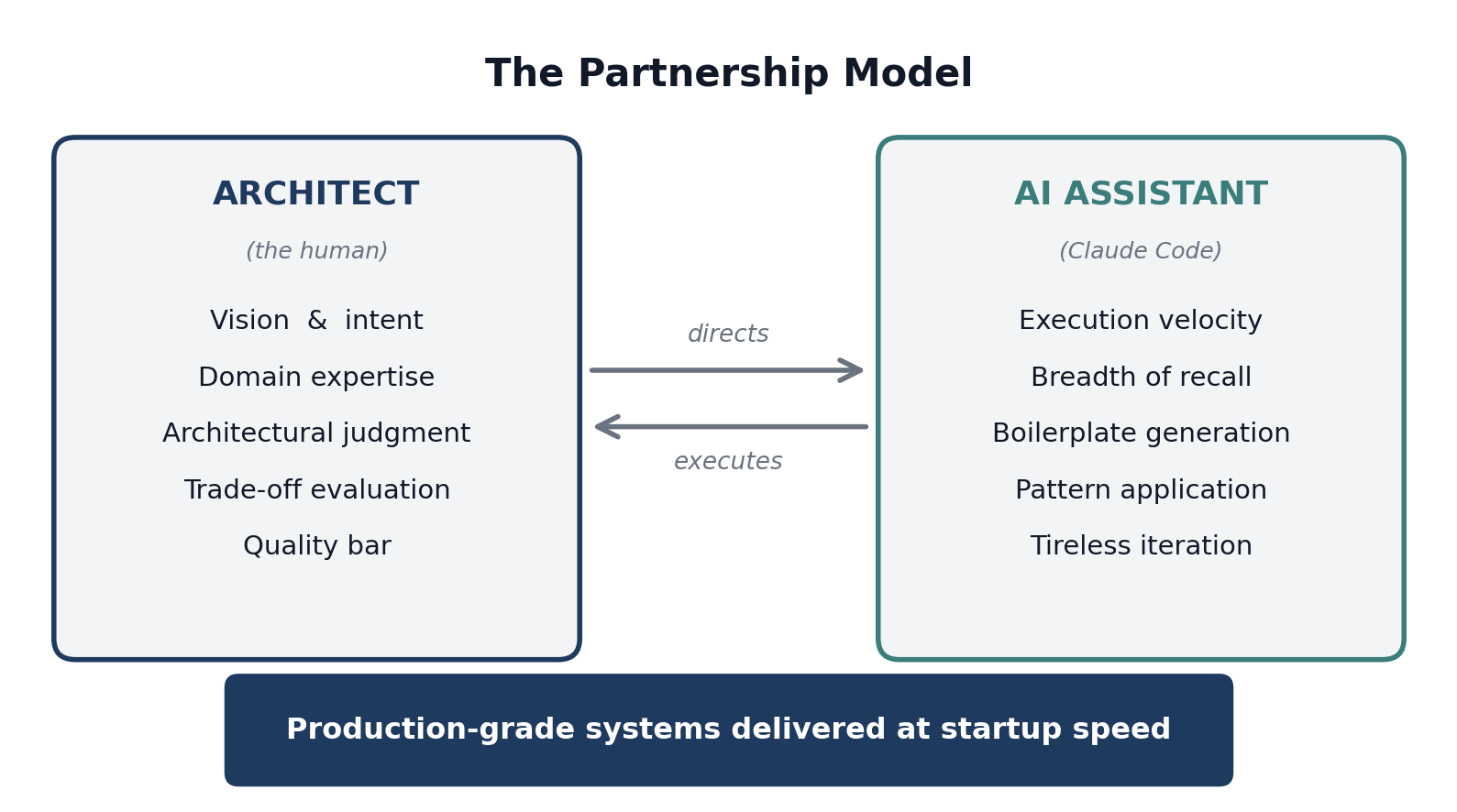
Treat the AI as a force-multiplier on your judgment, not a substitute for it. Bring expertise to the AI, and the velocity gain compounds. Bring vibes only, and the system inherits whatever the AI happens to invent.
2. Architecture First: Foundational Decisions Compound
One of the most underappreciated dynamics in AI-assisted development is the compounding effect of foundational framework decisions. These choices feel small at the start — a library here, a pattern there — but they determine the velocity ceiling for everything that follows.
In this project, several early decisions proved consequential:
- React Query for server state eliminated an entire class of loading, caching, and synchronization bugs before they could appear.
- Zustand for client state with persistence kept the application's global filters and view state coherent across sessions without complex boilerplate.
- Sequelize ORM with raw SQL fallback provided the ergonomics of model-based queries while allowing escape hatches when the ORM became a liability (as it did with MySQL's JSON/binary charset bug).
- MySQL CHECK constraints and ENUMs enforced business rules at the data layer, so seed errors surfaced immediately with clear messages rather than silently corrupting application state.
- A specialized third-party engine for the hardest domain capability — in this build, enterprise geospatial mapping — delivered in weeks what would have taken months to replicate with lower-level tools. (Buy the heavy-lift capability; build the differentiated logic.)
When these foundations are right, development velocity compounds. Each new feature — multi-stage workflows, portfolio and entity management, analytics, AI integration — builds on a stable base without carrying the weight of earlier architectural mistakes. Two months to build a system of this complexity is only possible because the foundation held.
When foundations are wrong, every feature becomes a negotiation with the limitations of the previous one. The AI can help you build faster on a bad foundation, but it cannot save the build from collapsing entirely.
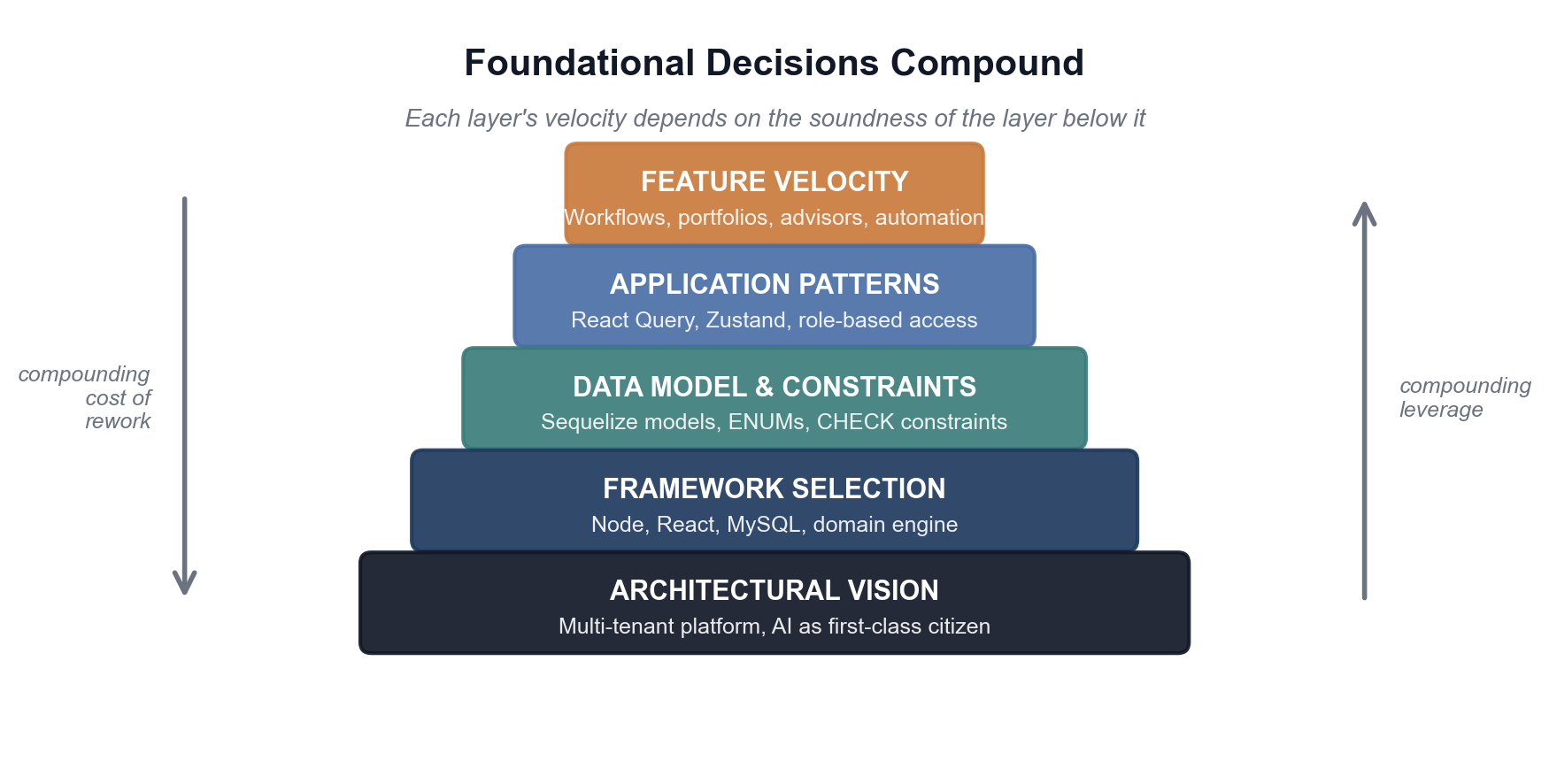
Invest disproportionate time in framework selection before writing a single line of feature code. The AI can help you evaluate trade-offs, but the decision must be yours — and it must be deliberate.
3. Dependency-Driven Development: Order Is Not Optional
Complex systems have dependency graphs. Data depends on reference tables. Users depend on clients. Core records depend on users. Histories depend on records. Derived datasets depend on the entities they describe. Scores depend on those datasets.
This sounds obvious when stated plainly. In practice, it is one of the most common sources of cascading failures in AI-assisted development — because the AI, left to its own devices, will solve the immediate problem without always accounting for the full dependency chain.
During the test-environment migration, seed-script failures cascaded for exactly this reason. A missing reference table caused foreign-key failures in dependent records. Missing stored procedures caused a downstream initialization step to fail. A seed script that ran only in development left key entity links absent in test, causing a filter to silently hide every record in the frontend.
The solution was a fully automated setup script that encoded the dependency graph explicitly — not as documentation, but as executable code. Every seed runs in the correct order. Every phase gate verifies its prerequisites. The system is now reproducible from scratch on any machine with a single command.
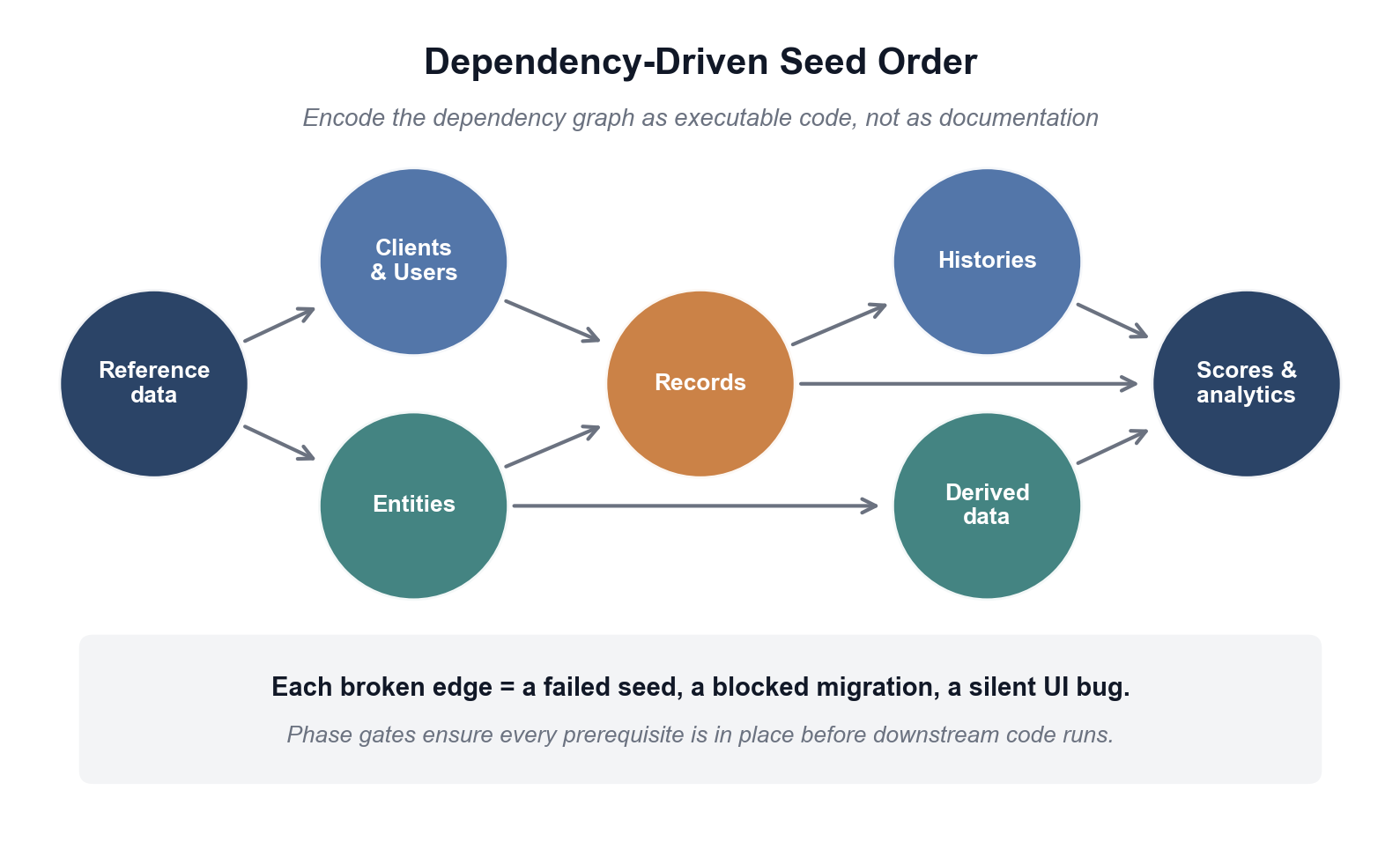
Encode your dependency graph as executable code, not as a wiki page. Phase gates and prerequisite checks are the difference between systems that work and systems that work only in demos.
4. AI as a First-Class System Citizen: Woven In, Not Bolted On
The most architecturally distinctive aspect of this project was the treatment of AI not as a feature, but as a participant in the system.
Most applications that claim "AI integration" add a chat widget that accepts free-text questions and returns generic responses. The AI knows nothing about the application's data, the user's context, or the business domain. It is bolted on — present, but peripheral.
In this system, the AI advisor is wired into the core workflows, the surrounding context, the underlying financials, and the comparative benchmarks. When a user asks about a record, the AI already knows that record's stage, its score, the comparable records in its segment, the relevant aggregate statistics, and the portfolio's performance metrics. The AI's response is grounded in the actual state of the system, not generic knowledge.
This required deliberate architectural decisions: a prompt-construction pipeline that assembles live context before each AI call, a persona abstraction layer that allows the AI's identity and behavior to be configured per client, a caching layer that avoids redundant API calls while keeping responses fresh, and an insight-invalidation system that clears cached responses when underlying data changes.
From Advisor to Agent: Three Modes of AI in the Workflow
Three distinct modes of AI participation now coexist in this system, each with its own architectural requirements and governance posture.
Generative AI — already deployed. The system uses generative AI to produce structured business artifacts: contracts, agreements, formal responses, and similar lifecycle documents. This is not AI answering questions; it is AI authoring content the business actually sends. Each document is generated from the live system state — transaction terms, counterparty details, contextual data, and client persona — and conforms to templates and policy constraints enforced by the platform. The architectural payoff is significant: a contract that previously took an analyst forty-five minutes to assemble, review, and reconcile now drafts in seconds, with the workflow data already correctly populated.
Agentic AI — incorporated, balanced with Human-in-the-Loop. Beyond generating content on request, the system now runs agentic AI: AI that takes initiative, triggers automation rules, monitors the workflow, and proactively surfaces opportunities before the user thinks to ask. A prioritization engine ranks incoming opportunities against a client's criteria; inbound requests are read and assessed automatically; an external signal scanner watches for relevant events and qualifies them; an event-driven automation engine reacts to changes in system state. What made this shippable rather than reckless was not the agentic capability itself — that is the easy part — but the discipline of pairing every agentic action with a calibrated trust boundary. The architecture deliberately defines the action space (what the AI is permitted to do) and the escalation path (under what conditions, with what evidence, and to whom it defers), so that initiative is always balanced against human control. You do not earn the right to act autonomously by being clever; you earn it by being governable.
Human-in-the-Loop — the governance layer that makes both viable. Neither generative nor agentic AI ships safely into a fiduciary or regulated domain without explicit Human-in-the-Loop (HiL) controls. A generated contract or agreement must be reviewable, editable, and explicitly approvable by a human before it reaches a counterparty, with the audit trail of who approved what — and from which AI-generated draft — preserved. Agentic actions require approval gates calibrated to the stakes: low-risk operations may auto-execute with no notification, while high-stakes operations require explicit confirmation from a named role-holder. HiL is not a friction layer bolted on at the end; it is an architectural pattern designed in from the start. Without it, generative output is a liability and agentic action is a blast radius.
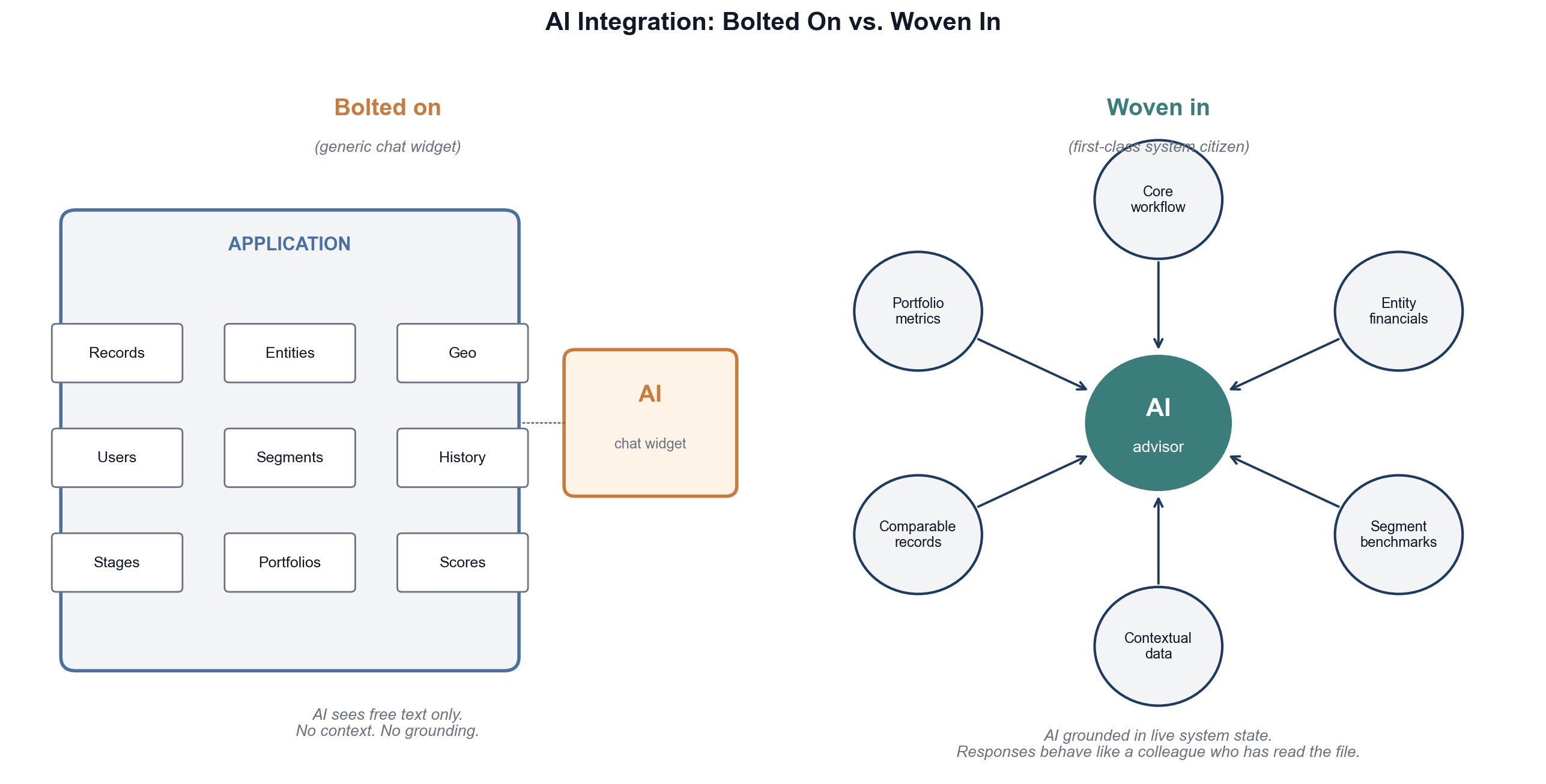
Design AI context, approval gates, and audit paths into the system from day one. Generative and agentic AI without Human-in-the-Loop is a demo; with HiL, it is a production system.
5. Platform Thinking: Multi-Tenancy and Configurability as Architectural Imperatives
There is a meaningful difference between building a system and building a platform. A system solves today's problem for today's user. A platform solves a class of problems for a class of users — including users and problems that don't exist yet.
This distinction requires an architect's mindset. Developers, naturally and correctly, optimize for the immediate requirement. Architects optimize for extensibility — the ability to absorb new requirements without structural rework.
In this project, multi-tenancy was not an afterthought. Every data model, every API endpoint, every access-control decision was designed around the reality that multiple clients — each with their own users, records, portfolios, segments, and AI-persona configurations — would coexist in the same system without visibility into each other's data. Client scoping was enforced at the query layer, not the application layer. Role-based access control distinguished platform administrators from client administrators from standard users. The AI advisor's persona — its name, voice, behavior, and prompt configuration — is configurable per client.
This level of configurability does not emerge from feature development. It emerges from a prior decision: this will be a platform, not a point solution. That decision shapes every subsequent choice, from database schema to API contract to frontend state management.
Multi-tenancy and configurability are architectural decisions, not features. They must be designed in from the start. The AI cannot make the leap from point solution to platform on your behalf — it can only execute the vision you bring.
6. Security as a First-Class Tenet, Engrained in Every Layer
Designed in at every layer — never bolted on.
Security is the dimension where the gap between a demo and a production system is widest — and the one an AI assistant will quietly under-serve unless you make it a standing requirement. Left to its defaults, AI-generated code will happily ship an endpoint without an authorization check, store a secret in plaintext, trust a client-supplied identifier, or let one tenant read another's data. None of these are exotic; all of them are catastrophic in a fiduciary or regulated domain. The discipline that prevents them is to treat security not as a feature added before launch, but as a tenet engrained in every layer: authentication and role-based authorization at the API boundary, tenant scoping enforced at the query layer so cross-tenant access is structurally impossible, encryption of sensitive data at rest, parameterized queries and input validation against injection, and secure-by-default configuration everywhere.
The practical mechanism is to adopt a security framework — or two — and hold the entire codebase compliant to it continuously, rather than auditing once at the end. In this project that meant a deliberate threat pass against a recognized model, a consolidated role-and-capability scheme verified by automated tests, encryption-at-rest behind a single key-management path, and an authentication-and-password policy enforced at the one place every credential is set. The AI is an able executor of these controls once they are specified — it will wire authorization into every route and scope every query when told to — but it will not impose them on your behalf. The standard has to come from the architect, and it has to be non-negotiable.
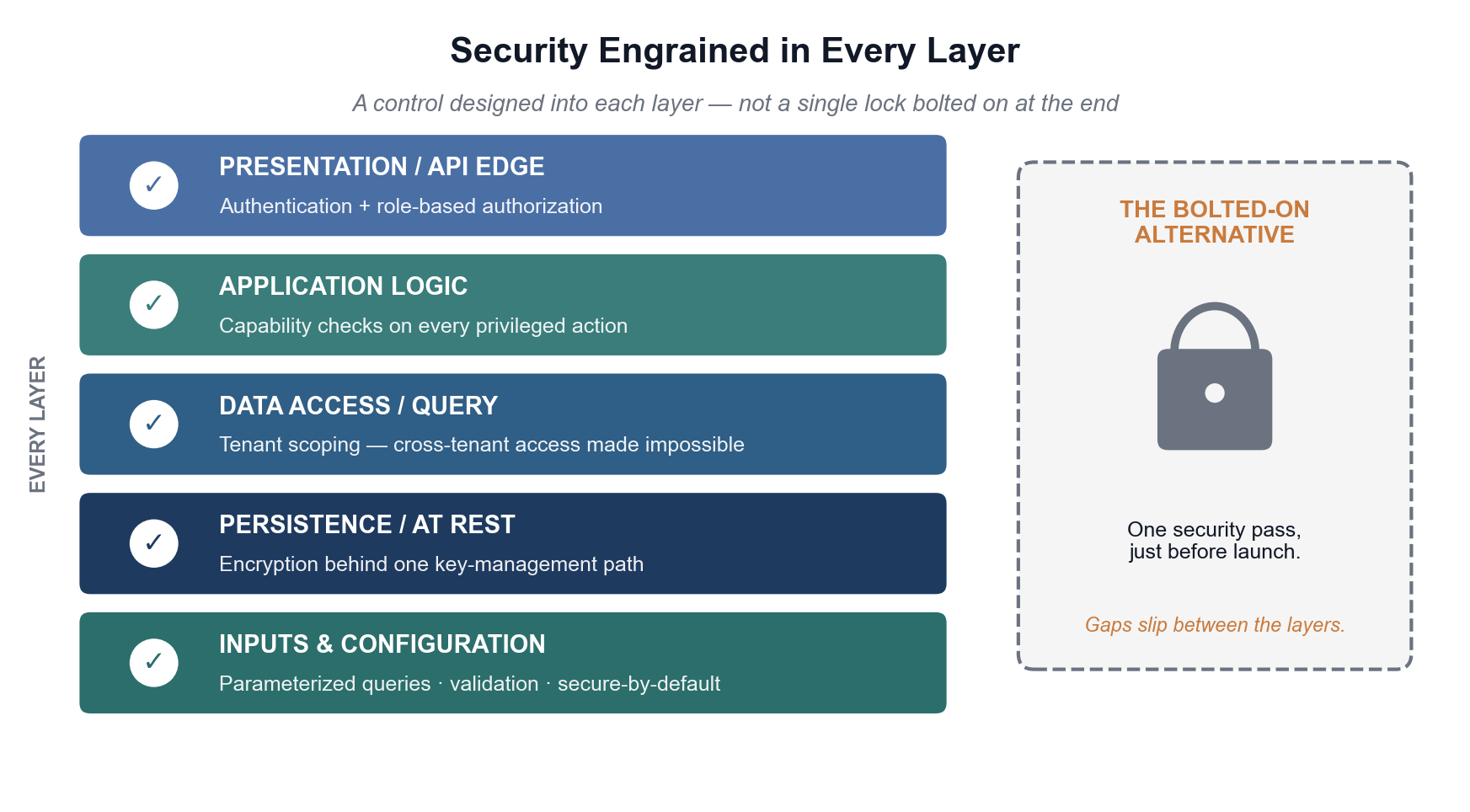
Security is not a feature you add before launch; it is a tenet you engrain in every layer from the first commit. Pick a framework, hold the whole codebase compliant to it continuously, and make the standard non-negotiable — the AI enforces what you specify, but it will never raise the bar on its own.
7. Earning the User's Trust: Human-in-the-Loop as a Design Principle
AI that acts in a user's name is adopted only when the user stays in control.
An AI feature can be technically impressive and still fail commercially if users do not trust it. In a domain where the AI drafts a contract, assesses an inbound request, or could one day trigger an action in a live workflow, the user's question is not "is it clever?" but "can I trust what it does in my name?" That trust is not won by accuracy claims; it is won by giving the user control. This is what makes Human-in-the-Loop (HiL) an essential property of a trusted system rather than a compliance checkbox: every AI-authored artifact is presented as a reviewable, editable draft that a named human must explicitly approve before it has any external effect, and every AI-eligible action carries an approval gate calibrated to its stakes. The user sees what the AI proposes, understands why, can change it, and remains the one who decides.
This is also what unlocks adoption. Users extend trust incrementally — they let the AI draft before they let it send, suggest before they let it act — and they grant more autonomy only as the system earns it through a visible track record. Designing for that arc, with transparent reasoning, an audit trail of who approved what and from which AI-generated draft, and gates the user controls, is what converts an AI capability into a feature people actually rely on. Human-in-the-Loop is therefore not the brake on AI value; it is the on-ramp to it.
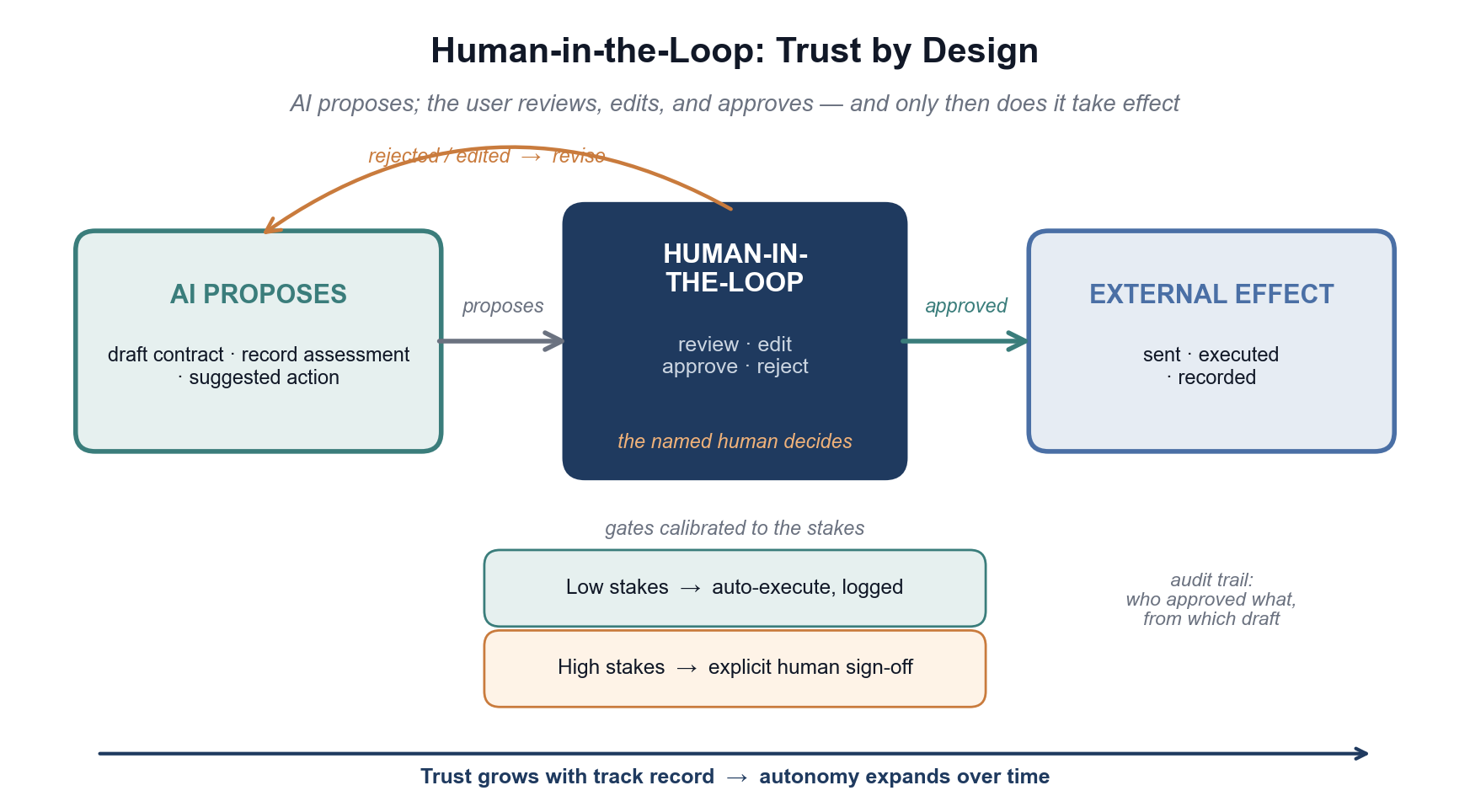
Users adopt embedded AI only when they trust it, and they trust it only when they stay in control. Human-in-the-Loop — reviewable drafts, explicit approval, and an audit trail — is the design principle that earns that trust, and with it, adoption.
8. The Volume Surprise: When Coding Is No Longer the Bottleneck
One of the most striking aspects of AI-assisted development, experienced firsthand over these two months, is the sheer volume of code produced without the human's hands on a single line of source code.
Seed scripts, controllers, migrations, TypeScript fixes, stored procedures, setup automation, documentation was written, debugged, and iterated without the architect touching a file. The coding bottleneck, which historically constrained how quickly ideas could be realized, effectively disappeared.
This is good news for experienced architects and bad news for those who assumed AI would democratize software development by making architectural judgment unnecessary. It has not. It has made architectural judgment more valuable, not less, because the cost of acting on good judgment has dropped dramatically while the cost of acting on poor judgment has remained the same.
Invest in your ability to think clearly about systems, trade-offs, and requirements. That is what compounds. The limiting factor in velocity is no longer how fast you can write code — it is how clearly you can articulate what you want and how soundly you can evaluate what you receive.
9. Knowing the Problem Space: Domain Expertise as the Ultimate Co-Pilot
There is a dimension of AI-assisted development that receives almost no attention in the vibe coding conversation: the depth of your domain knowledge determines the quality of what you can build.
An AI coding assistant is, among other things, a reasoning partner. It can propose solutions, evaluate trade-offs, suggest alternatives, and identify edge cases. But the quality of that reasoning is bounded by the quality of the problem framing it receives — and problem framing is an act of domain expertise, not technical skill.
In this project, the problem space was a complex, regulated B2B domain. Knowing that the core entity moves through a pipeline of discrete stages with specific business rules at each transition, that records can be killed and resurrected, that ordinarily-sequential processes can run concurrently, that one lifecycle is fundamentally different from its mirror-image counterpart — shaped the entire data model. Knowing which financial and operational metrics actually drive decisions in that domain shaped the analytics layer. Knowing how practitioners in the field really reason about their world — its units, its structure, its relationships — shaped the rest of the architecture.
None of this domain knowledge came from the AI. It came from the architect. Without it, the AI would have produced a generic CRUD application — technically functional, commercially useless.
The ability to co-debate solutions with an AI is equally dependent on domain knowledge. When the AI proposed a particular approach to stage-history modeling, the architect could evaluate it against the actual business reality: records don't simply move forward; they die, resurrect, run concurrently, and carry audit trails that matter for downstream reporting and compliance. That evaluation required knowing what the system needed to mean, not just what it needed to do.
Invest in domain knowledge as aggressively as you invest in prompting technique. The deepest competitive advantage in AI-assisted development is knowing your problem domain well enough to recognize a wrong answer.
10. Who Survives the Vibe Coding Era: The Architect as the New Bridge
The most disruptive question vibe coding raises is not technical — it is existential: does this eliminate software developers, and can end users now build fully functional systems on their own?
The honest answer is nuanced, and it matters enormously for anyone navigating a career in technology today.
The end user can go further than ever before — but hits a wall. Simple tools, internal utilities, single-screen prototypes, personal automation scripts are genuinely within reach of a motivated non-technical user armed with an AI coding assistant. The barrier to producing something that works has never been lower. This is real and significant.
But "something that works" and "a fully functional production system" are not the same thing. The wall appears when complexity accumulates: when the system needs to serve multiple users with different roles and permissions; when it needs to deploy to a separate environment and behave the same way; when it must handle encrypted data consistently across machines; when it needs to integrate with external APIs and third-party data systems; when it needs to be maintainable by someone other than the person who built it.
At that wall, the end user without architectural training does not just slow down — they stop. Not because the AI becomes less capable, but because the questions required to direct the AI become questions the end user cannot ask.
The typical software developer is significantly disrupted. The AI can now do much of what junior and mid-level developers do — write boilerplate, implement specified features, fix known error patterns, generate tests. The demand for developers who primarily translate requirements into code, without contributing deeper system judgment, will contract. This is not speculation; it is already observable in hiring patterns across the industry.
The architect becomes the essential bridge. If end users cannot direct the AI past a certain complexity threshold, and the traditional developer's role is being absorbed by the AI itself, then the question becomes: who fills the gap? The architect does — and in the AI era, that architect is most valuable when forward-deployed: embedded directly in the problem, building alongside the AI rather than handing specifications down a chain. This is the Forward-Deployed Engineer, and it is the role this entire paper has been describing.
The architect should not merely be a title or a role in an org chart — rather, the architect as a mode of thinking. Someone who understands systems holistically: how data flows, how components couple and decouple, how today's decisions constrain tomorrow's options, how a platform differs from a point solution, how security and scalability and maintainability are not features to be added later but properties to be designed in from the start.
This is precisely the profile that makes AI-assisted development sing. The architect brings vision, judgment, and domain expertise. The AI brings execution velocity. Together they can produce in two months what would previously have taken a team of developers six months — but only if the architect is genuinely in the chair, making genuine architectural decisions, not simply hoping the AI figures it out.
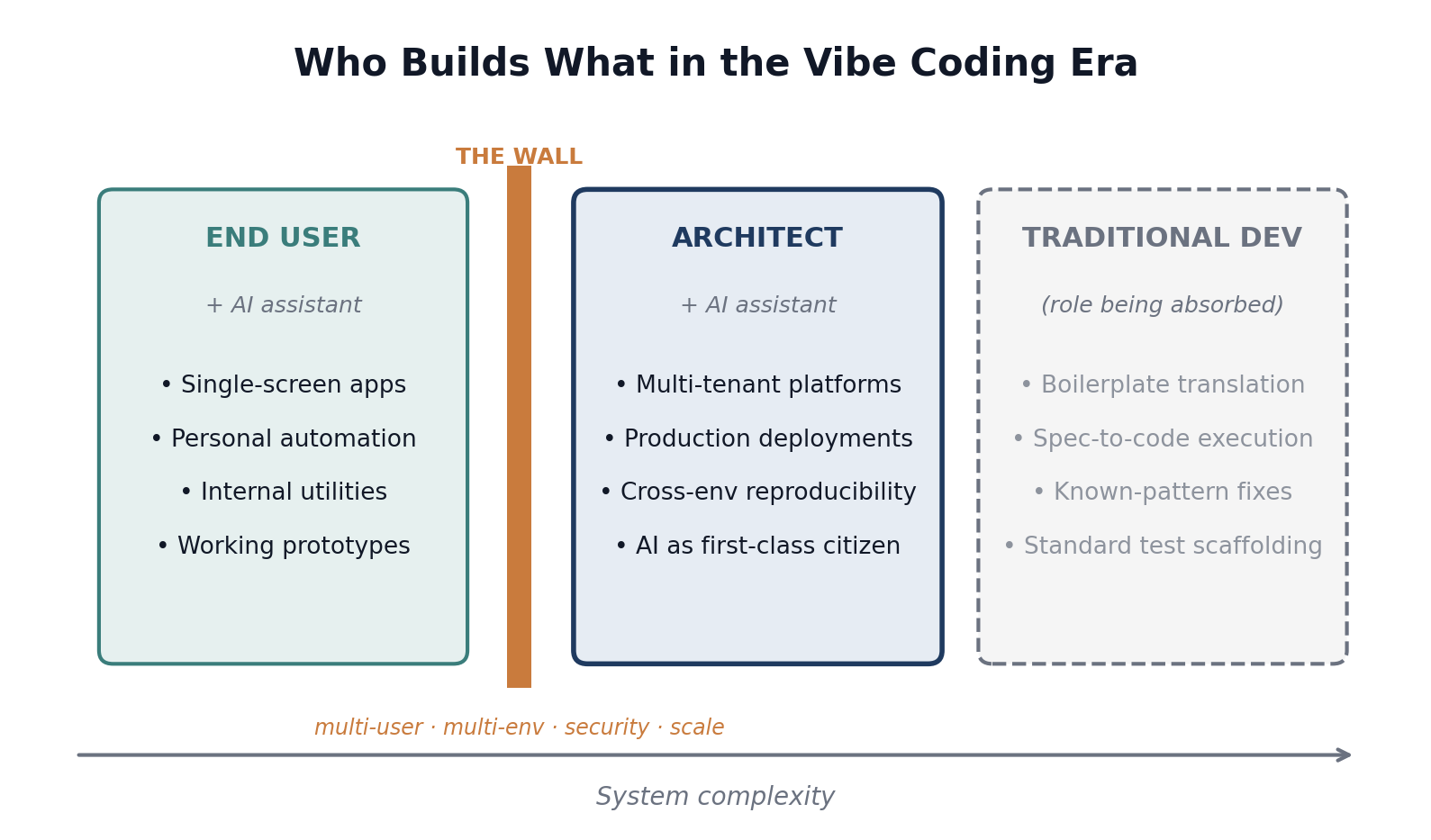
The most important investment you can make is not in learning to prompt better. It is in developing the architectural judgment that makes your prompts worth executing. Study systems. Build things that break. Understand why they broke. Develop opinions about trade-offs.
11. The Frustration Tax: Being Honest About What Still Breaks
Any honest account of AI-assisted development must acknowledge the frustration tax.
Over two months, the same login failure appeared multiple times, each time by a different root cause: a missing client/.env file, a wrong CORS port, an encryption-key mismatch, an API server bound to localhost instead of all network interfaces. Each failure looked identical on the surface. Each required a different fix.
The AI's tendency in these situations is to address the most recent hypothesis rather than the root cause, because it cannot see the full system state — only what it is told. The human's role is to provide the diagnostic information that narrows the hypothesis space, to recognize when a fix is treating a symptom rather than a cause, and to push back when a solution feels incomplete.
The tax is real. It is also manageable — and it decreases as the human learns to provide richer context upfront, to describe not just what broke but what changed before it broke, and to distinguish between "the system is wrong" and "my mental model of the system is wrong."
AI-assisted development is faster and more productive than the alternative. It is not frictionless. The frustration is part of the process, not a sign that something is wrong.
Conclusion: Eleven Lessons for Aspiring Vibe Coders
The vibe coding movement has unlocked significant new possibilities. But the most successful practitioners will not be those who treat AI as a replacement for expertise — they will be those who bring expertise to the AI and use it as a force multiplier.
From two months of building a production-grade system with Claude Code, the distilled lessons are:
- Your judgment is the product. The AI writes the code. You decide what to build, in what order, on what foundation, and whether the result is good enough.
- Invest in foundations before features. Framework choices, data-model decisions, and dependency graphs made early determine the velocity ceiling for everything that follows.
- Know your dependency order. Complex systems have graphs. Encode them explicitly. Enforce them automatically.
- Design for AI context from day one. If AI is part of your system, treat it as a first-class participant with access to your data — not as a chat widget bolted on at the end.
- Think platform, not point solution. Multi-tenancy and configurability are architectural decisions, not features. The AI will build exactly what you describe.
- Engrain security in every layer. Authorization, tenant isolation, and encryption are tenets to design in from the first commit, not an audit before launch. Pick a framework and hold the whole codebase compliant — the AI enforces what you specify, but never raises the bar itself.
- Earn the user's trust with Human-in-the-Loop. Embedded AI is adopted only when users stay in control — reviewable drafts, explicit approval, and an audit trail. HiL is the on-ramp to AI value, not the brake on it.
- The coding bottleneck is gone. The thinking bottleneck remains. Invest in your ability to think clearly about systems, trade-offs, and requirements.
- Know your problem space deeply. Domain expertise is the ultimate co-pilot. You must know enough to recognize when output is technically correct but semantically wrong.
- The architect is the new bridge. End users go further than ever with AI — but they hit a wall at system complexity. Architects bridge that gap.
- Pay the frustration tax honestly. AI-assisted development is faster and more productive than the alternative. The friction is part of the process, not a defect.
The journey is worth it. Build something real, and you will find out exactly what you are made of — and what the AI is made of too. That is the work of the Forward-Deployed Engineer: judgment embedded where the building happens, amplified by AI, accountable to production. Whatever the industry, whatever the product, it is the role the AI era rewards most.
About This Paper
This whitepaper was developed from direct practitioner experience building a full-stack, multi-tenant production platform using Claude Code over a two-month development sprint. It reflects observations from real engineering work, not abstract theorizing. This is the product- and industry-agnostic edition: the case study is anonymized by design so the lessons apply to any production platform you set out to build — the engineering is not. The framing role throughout is the Forward-Deployed Engineer. Topics covered: the architect–AI partnership model, foundational decisions and their compounding effects, dependency-driven development, first-class AI integration patterns, multi-tenant platform architecture, security engrained at every layer, trust through Human-in-the-Loop, domain expertise as a force multiplier, the Forward-Deployed Engineer as the role the AI era rewards, and the career implications for end users, developers, and architects.
Acknowledgements
The last two months of my marriage with Claude Code would not have been possible had it not been for my wife's whole-hearted support and encouragement. She not only allowed me to be married to another persona (Claude Code, just to be clear) but also challenged my self-doubt. I would not be where I am without my life partner, Tulasi!